Nine years. Near-perfect performance. Top ratings every single year. "Ready Now" for VP — three years in a row. On paper, I was the answer. Then the slot opened. They gave it to someone ranked lower than me.
I did what most of us do. Told myself it was politics. Put my head down and delivered more. Built a bigger portfolio. And when the slot opened again a few years later, they promoted a peer Director. Not me. Again.
If you've ever sat in a review where your boss literally said "you're one of our strongest" and then watched someone else get the job — you know this feeling. It's not anger. It's confusion. Because they're not better at the work. So what are they better at?
Here's what made it worse. My readiness rating didn't plateau — it went backwards. Ready Now. Ready Now. Ready Now. Then Ready with Development. Then Professional. That's the lowest tier. A demotion on paper while I was leading a platform replacement that saved the organization tens of millions compared to what the same project cost a decade earlier.
It took me years to figure out why. And when I did, I realized I had been solving the wrong problem the entire time.
The Room You're Not In
After I moved into executive management, my organization started including me in calibration sessions. Directors, VPs, and the CIO sit in a room and discuss promotion potential for everyone below them. Who's ready for executive management. Who's Director material. Who's VP material. Hundreds of people's careers, discussed in a few hours.
The first time I sat in that room was a gut punch.
The level of knowledge each leader had about their people varied wildly. I knew great performers — people I'd worked with personally — who never got mentioned. Not because they were bad. Because nobody in that room had them top of mind. They weren't visible.
And the people who were visible? They weren't always visible for the right reasons.
Every leader in that room defaulted to the same thing: recency. Nobody sat down beforehand and mapped out each person's full track record, their career goals, what they'd delivered over the past three years. With hundreds of people, that's impossible. So the system defaults to: who can I remember right now? That's the visibility paradox — your work is current, but your reputation isn't.
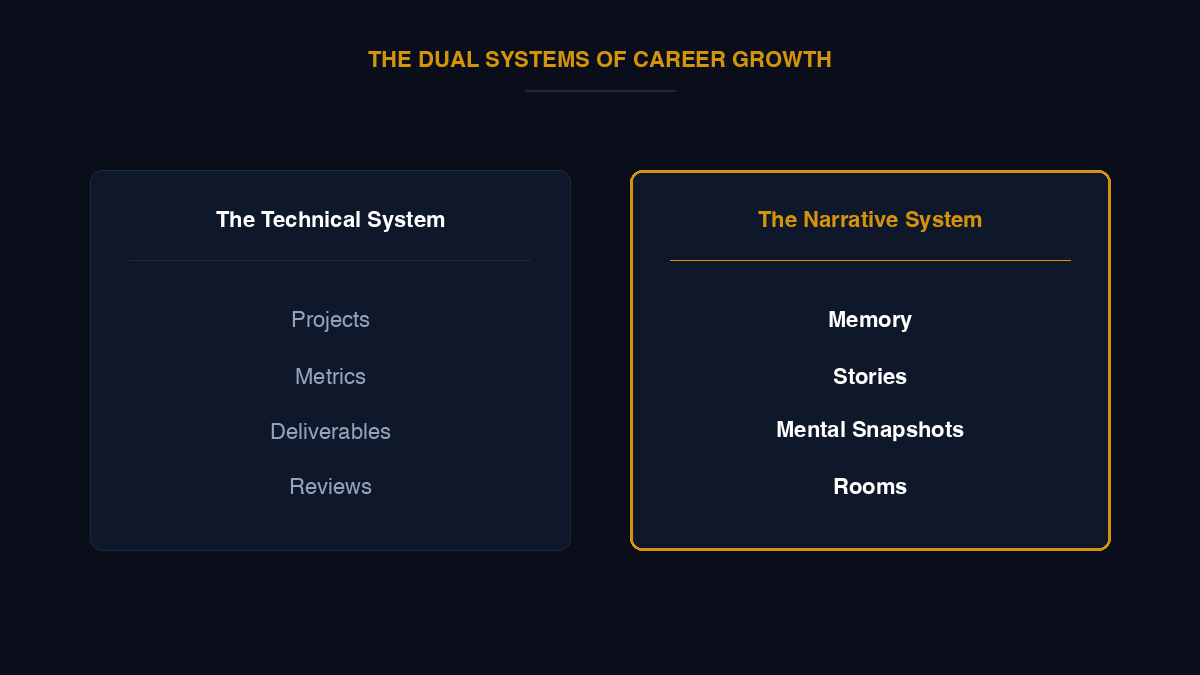
That's when it hit me. There are two systems running in every organization.
The first is the technical system — the work you were hired to do. You know this system. You're probably excellent at it.
The second is the narrative system — what people remember about you, what gets said when your name comes up in a room you're not in, and what decisions get made about your career without you present.
The wrong problem I'd been solving? I was grinding on the wrong variable entirely. I needed to work the narrative.
Tim's Story
Before I was a Director, I was a manager sitting in the CIO's office. The CTO was telling me who the new embedded IT person would be for a business unit that had already decided they didn't need us. Their words — almost verbatim — were "we don't need IT, we already have our vendor." Shadow IT was entrenched. IT was irrelevant before anyone set foot in the unit.
The CTO had a name in mind. Someone who knew the tools, who could hit the ground running technically. A surface-level match.
I pushed back. I nominated Tim.
Not because Tim was the most technically qualified. Because Tim didn't just understand problems — Tim brought solutions. The other candidate knew the tools. Tim would walk into a room that had already written IT off, figure out what was actually blocking them, and fix it before it bounced back up the chain. Anyone can document a problem. Tim solved it. That's a different animal — and that's what that environment needed.
I reminded the CTO of what Tim had done before — when we needed Linux expertise, we sent Tim overseas to work with a vendor partner on building a solution from scratch. He was a Windows server admin at the time. He also built specialized hardware with a second partner that the project required. Tim knew how to listen, analyze, and then move the needle.
The CTO's memories came back. He recommended Tim instead.
Tim walked into that hostile business unit. Turned it around completely. Won recognition from leaders who never compliment anyone. Got promoted to executive management.
I didn't change Tim's skills. I changed his context. I wrote to the narrative system on his behalf — I put his name in a room he wasn't in, with evidence that mattered.
This isn't manipulation. This is professional survival.
The Three Shifts
Once I understood the system, I made three changes. Not to the work itself — to how the work moved through the organization.
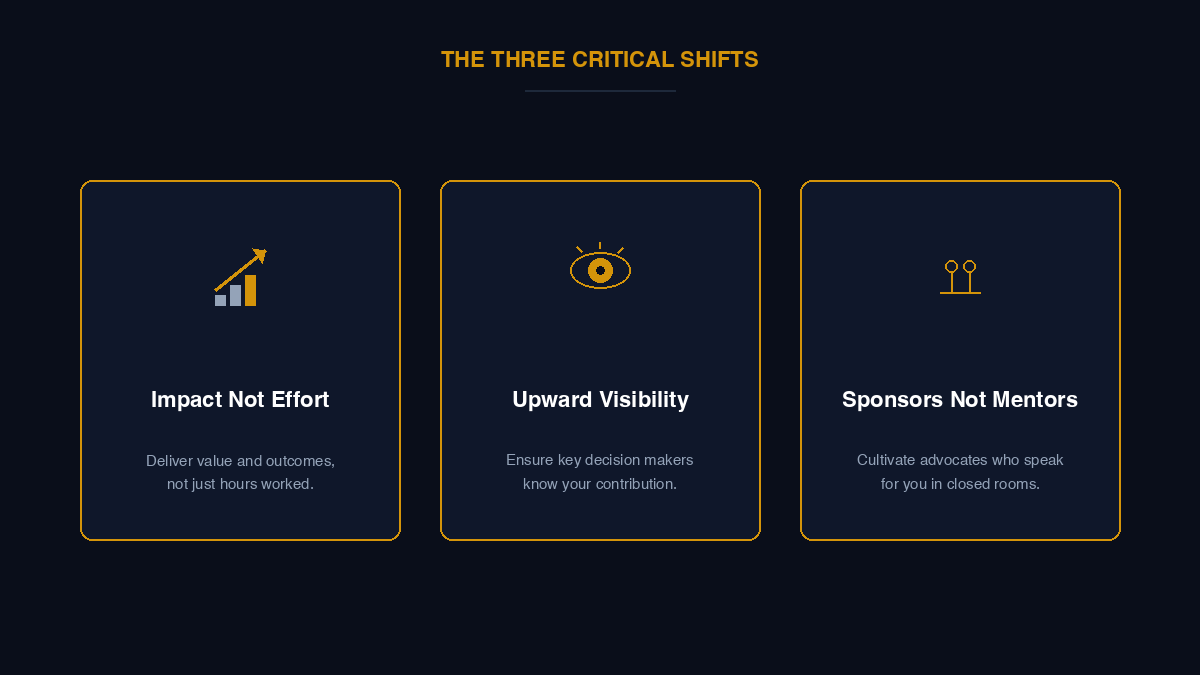
- Report impact, not effort — translate what you did into what it enabled
- Build upward visibility deliberately — stop relying on your boss to carry your story
- Seek sponsors, not just mentors — find people who say your name in rooms you're not in
1. Report impact, not effort.
I stopped telling people how hard I worked and started telling them what the work enabled. Not "here's how many hours I put in" but "here's what this project saved, generated, or unlocked." The same work, translated into the language the narrative system actually records.
Here's what that sounds like in practice: "The platform migration we wrapped last quarter reduced our incident resolution time by 40%. That freed up about eight hours of engineering capacity per week." Same work. Different frame. That's the version that gets written into memory — and into the room you're not in.
2. Build upward visibility deliberately.
I stopped relying on my boss to translate my work to leadership. Your boss can't champion work they can't explain — that was the lesson. If my boss's boss didn't know what I delivered, it didn't exist in the narrative system. I started creating the translation layer myself — briefing upward, making it easy for leaders two levels above me to know my name and attach it to outcomes.
3. Seek sponsors, not just mentors.
Mentors give advice. Sponsors say your name in rooms you're not in. That's the difference between being coached and being promoted. I stopped spending time with people who could help me think and started spending time with people who could help me move. (If you want the exact moves for turning a high-friction assignment into a narrative reset, the Strategic Assignment Playbook walks through all four.)
What I Finally Understood
That peer Director who got the VP job over me? He's my boss now. We get along well. He's as good as me — maybe better in some ways. I have him on technical ability and creative thinking. He has me on political savvy and interpersonal skills.
The promotion didn't go to someone less qualified. It went to someone who was better at the game I didn't know I was playing.
Research shows only one in three high performers are also rated as "high potentials" by leadership. Your performance review and your promotion case are two completely different documents. And most of us only know about one of them.
The work was never the problem. The work was always the proof. You just needed someone in the right room to present it — and for most of us, that someone has to be you. If you want the complete system for writing to the narrative — frameworks, AI templates, and a 30-day implementation roadmap — that's what the Executive Visibility Playbook was built for.
Start writing to the narrative system. That's the game. Now you know it exists.
Frequently Asked Questions
Why do less qualified people get promoted over me?
Because promotions aren't decided by the technical system — they're decided by the narrative system. The technical system scores what you deliver. The narrative system scores what people remember about you when your name comes up in a room you're not in. Your peers who advance aren't outperforming you. They're writing to a different system.
What is the narrative system in organizations?
Every organization runs two systems simultaneously. The technical system is the work — projects, deliverables, performance metrics. The narrative system is the story — what gets said about you in calibration sessions, how leadership describes you in one sentence, what mental snapshot exists of you in your skip-level's mind. Most technical professionals spend their entire career optimizing the first system and never learn the second one exists.
How do I report impact instead of effort?
Stop telling people how hard you worked and start telling them what the work enabled. Not "we spent three months on the platform migration" — instead, "the platform migration reduced incident resolution time by 40% and freed eight hours of engineering capacity per week." Same work. Different frame. The second version is what the narrative system records.
How do I get promoted in a large organization?
Three shifts: report impact not effort, build upward visibility deliberately (don't rely on your boss to translate your work), and seek sponsors not just mentors. The fastest path isn't doing more work — it's becoming visible to the right people for the right reasons. One in three high performers are also rated as high potentials. Your performance review and your promotion case are two different documents.